A backyard path does more than connect two points. Done right, it gives your outdoor space a sense of order, directs movement naturally through the yard, and adds a level of polish that elevates the entire property. Done poorly — with pavers that shift, edges that crumble, or materials that clash with the surroundings — it becomes an eyesore and a maintenance headache.
For homeowners in Cleveland, TN, where yards range from flat open lawns to sloped, wooded properties, the design choices you make early in a path project have a big impact on how the finished result looks and how long it holds up. Here is how to approach backyard path design the way a professional would.
Start With Purpose, Not Materials
Before you pick a stone, brick, or paver, decide what the path is actually supposed to do. That decision drives everything else — the width, the route, the material, and the installation method.
Ask yourself:
- Is this a primary route that people will use daily to get from the patio to a gate, a garden area, or a detached structure? Primary paths need to be wider, more stable, and built from durable materials that hold up to regular foot traffic.
- Is this a decorative or accent path that guides the eye through a garden or connects visual elements in the yard? Decorative paths can use lighter materials, tighter spacing, and a less formal layout.
- Will this path need to handle equipment? If a lawn mower or wheelbarrow needs to pass over it, the materials and installation depth need to account for that load.
- Does it need to work at night? Paths that connect the house to a fire pit, a pool, or a back gate benefit significantly from integrated or adjacent lighting.
Skipping this step is what leads to paths that look disconnected from the rest of the yard — technically installed but not really designed.
Choose the Right Material for Tennessee’s Climate
Material choice is where most backyard path projects either come together or fall apart. Tennessee’s climate — hot humid summers, cold winters with occasional ice, and frequent heavy rain — puts stress on outdoor surfaces that many homeowners underestimate.
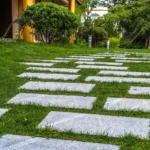
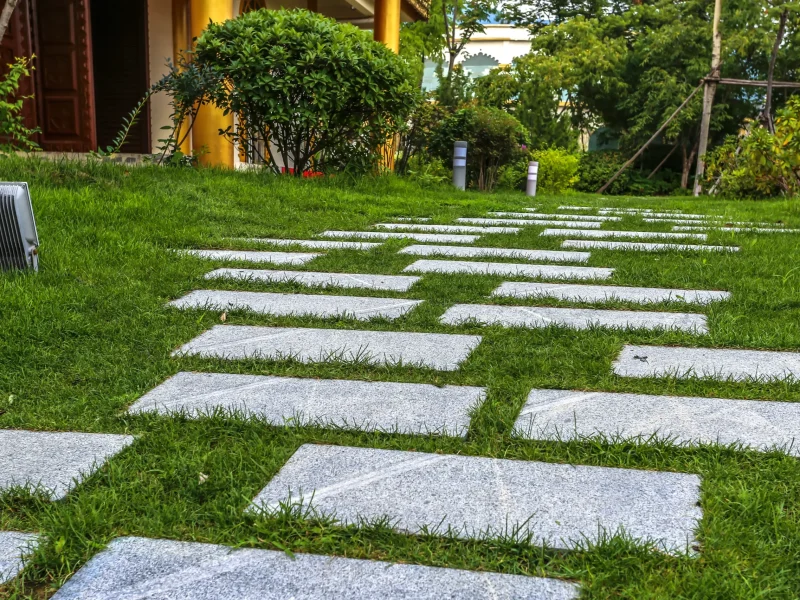
- Concrete stepping stones and granite pavers are among the most durable choices for Cleveland, TN. They hold up to freeze-thaw cycles without cracking, do not absorb moisture the way some materials do, and age well when properly installed. Granite pavers in particular have a natural look that blends with nearly every yard style and holds its appearance over years of outdoor exposure.
- Natural flagstone offers an irregular, organic look that works well in garden settings and heavily planted yards. It is an excellent choice for decorative paths where the goal is a relaxed, natural feel rather than a formal one. The trade-off is that flagstone requires more careful leveling during installation and can become slippery when wet if the surface texture is too smooth.
- Brick pavers give a more traditional, structured appearance and are a strong choice for paths that border formal gardens, raised beds, or symmetrical planting layouts. Brick holds up well in Tennessee’s climate when installed over a properly prepared base.
- Gravel and decomposed granite are low-cost options but come with trade-offs — they shift under foot traffic over time, require edging to stay contained, and can be difficult to navigate in wet conditions. For a truly professional result, solid pavers or stone are the better investment.
Lay Out the Route Before You Dig
One of the most useful things a professional landscaper does before installing a path is spend time observing the natural movement patterns across the yard. Where do people actually walk when moving from one area to another? Those worn patches of grass are telling you something.
The most successful backyard paths follow the natural desire line — the route people would take anyway — rather than forcing a perfectly straight or perfectly curved line that looks good on paper but feels awkward to actually walk.
To lay out a path before committing:
- Use a garden hose or rope to mark the proposed route on the ground and live with it for a day or two before digging
- Walk it several times at a normal pace and notice whether it feels natural or whether you instinctively cut a corner or veer to one side
- Check the sight lines from the house and the main patio or outdoor seating area — the path should look intentional from wherever you most often look at the yard
For stepping stone paths specifically, spacing matters as much as layout. Pavers spaced too far apart force an awkward stride; too close together and the path loses its open, airy look. A natural walking stride in a relaxed outdoor setting is roughly 18 to 24 inches from center to center, measured from the leading edge of one stone to the leading edge of the next.
Prepare the Base Properly
This is the step that separates a path that holds up over years from one that starts shifting and settling within the first season. In Cleveland, TN’s clay-heavy soils, proper base preparation is especially important because clay expands when wet and contracts when dry, creating movement beneath any surface installed directly on top of it.
For a stepping stone or paver path:
- Excavate to the right depth — typically four to six inches below finished grade for a stepping stone path set in lawn, or deeper if going over a gravel or sand base
- Add a compacted gravel base of two to four inches beneath the sand or setting material — this improves drainage and prevents the freeze-thaw movement that causes pavers to heave and shift over winter
- Use a leveling layer of coarse sand or stone dust directly beneath each paver to allow fine adjustments and ensure a flat, stable surface
- Check level frequently as you set each stone — a single paver that sits slightly higher than its neighbors creates a tripping hazard and makes the entire path look uneven
Skipping the gravel base and setting pavers directly in clay soil is the single most common reason backyard paths look fine the first year and start to fail in the second or third.
Think About the Edges
A professionally installed path has defined edges. The transition between the path and the surrounding lawn or planting bed is what gives the finished project its clean, intentional look — and it is often what separates a DIY result from a professionally installed one.
Options for edge treatment include:
- Lawn growing flush with the pavers, which works well for stepping stone paths set low in the turf — the grass naturally fills in between and around stones and creates a green, organic border that requires regular trimming to maintain cleanly
- Metal or plastic landscape edging installed along both sides of a gravel or paver path to keep material contained and prevent grass from encroaching over time
- Planting beds along the path edge, where low-growing plants, ground cover, or ornamental grasses soften the transition between hardscape and lawn and add visual interest along the route
- Decorative stone or brick border installed along the outer edge of the path, which creates a formal frame and emphasizes the path as a designed element of the yard
In Tennessee’s climate, the edges of a path take more abuse than the center — water runs to the edges first, and roots from nearby plants push hardest at the perimeter. Whatever edge treatment you choose, it needs to be installed as carefully as the path itself.
Add Lighting to Make It Work After Dark
Outdoor lighting along a backyard path is one of the most impactful additions you can make for both safety and aesthetics. A path that disappears into shadow after sunset limits how your outdoor space gets used — and a path that is well lit extends the usability of the yard through the evening hours.
For a professional look that does not feel overdone:
- Bollard lights placed at intervals along the path cast a low, directed glow that illuminates the walking surface without creating harsh glare — the style of light visible in the photo that inspired this article
- In-ground path lights set flush or nearly flush with the surface provide subtle, low-profile illumination that works well between stepping stones
- Solar lights are the simplest option for areas without nearby electrical access, though they require direct sun exposure to charge reliably and tend to have a shorter lifespan than wired fixtures
- Low-voltage wired lighting installed during the path project is the most reliable and long-lasting option, and it is far easier to run the wiring before the path is finished than to retrofit it afterward
Professional Hardscape and Landscaping Services in Cleveland, TN
At Perez Tree Services, we design and install backyard paths, stepping stone walkways, and hardscape features throughout Cleveland, TN and the surrounding areas. From initial layout and base preparation through final installation and edge treatment, our team builds paths that look professional, hold up through Tennessee’s seasons, and improve how your outdoor space functions every day.
Ready to add a path to your yard? Contact Perez Tree Services today to schedule a landscaping consultation in Cleveland, TN.